

Valid CCNP Enterprise 300-420 Dumps Ensure Your Passing
300-420 Dumps Real Exam Questions Test Engine Dumps Training
Network Services
The questions from this subject area cover 20% of the entire content and evaluate the candidates’ ability to perform the following operations:
- Design the policies for end-to-end QoS, including queuing, shaping, policing, marking & classification;
- Design SSM, MSDP, and PIM bi-directional multicast services.
- Explain the concepts of multicast routing (rendezvous points, source trees, shared trees, and RPF);
- Choose the relevant QoS strategies to meet the requirements of customers;
- Design the techniques for network management, such as prioritize network management traffic, in-band versus out-of-band, and segmented management networks;
NEW QUESTION 27
Which two border nodes are available in the Cisco SD-Access architecture? (Choose two.)
- A. anywhere border
- B. edge border
- C. intermediate border
- D. extended border
- E. internal border
Answer: A,E
Explanation:
There are 3 types of border nodes in SD-Access:
External. Default exit from fabric with no specific routes injection
Internal. Gateway only for a set of networks, such as shared services prefixes Anywhere. Combination of external and internal functionality
NEW QUESTION 28
Which component is part of the Cisco SD-Access overlay architecture?
- A. leaf node
- B. Cisco DNA Center
- C. border node
- D. spine node
Answer: B
NEW QUESTION 29
Drag and drop the descriptions from the left onto the Cisco SD-WAN component they describe on the right.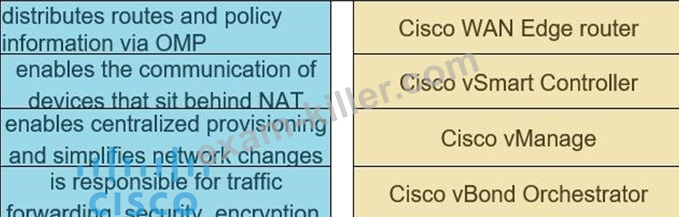
Answer:
Explanation: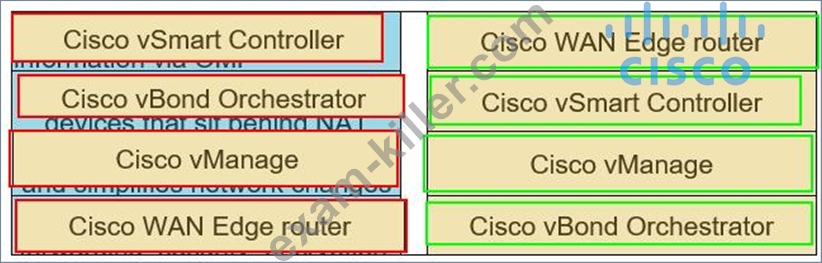
NEW QUESTION 30
Refer to the exhibit. AS65533 and AS65530 are announcing a partial Internet routing table as well as their IP subnets. An architect must create a design that ensures AS64512 become a transit AS. Which filtering solution must the architect choose?
- A. Maximum-prefix
- B. Next-hop
- C. No Export
- D. No-advertise
Answer: A
NEW QUESTION 31
Instructions
The main screen consists of two parts; the Main scenario and the Topology tabs. The main scenario describes TSHOOT.com test bed. The Topology tabs allow you to display the appropriate and select the trouble ticket.
To complete the item, you will first need to familiarize yourself with the TSHOOT.com test bed by clicking on the master scenario first and then the topologies tabs. Once you are familiar with the test bed and the topologies, you should start evaluating the trouble ticket. You will be presented with a Trouble Ticket scenario that will describe the fault condition. You will need to determine on which device the fault condition is located, to which technology the fault condition is related, and the solution to each trouble ticket. This will be done by answering three questions.
Ticket Selection
To begin, click on the Ticket on the Topology tabs.
Please note. Some of the questions will require you to use the scroll bar to see all options.
Fault Isolation
Read the ticket scenario to understand the fault condition.
Open the appropriate topology, based upon the ticket scenario.
Open the console of the desired device by clicking on that device in the topology, based upon your troubleshooting methodology.
Use the supported show, ping and trace commands to begin your fault isolation process.
Move to other devices as need by clicking on those devices within the topology.
Fault Identification
The trouble ticket will include three questions that you will need to answer:
1. Which device contains the fault
2. Which technology the fault condition is related to
3. What is the solution to the issue
To advance to the next question within the ticket click on "Next Question".
When you click "DONE", the trouble ticket will turn RED and will no longer be accessible.
You may also use the "Previous Question" button to review questions within that specific ticket.
To complete a trouble ticket, answer all three questions and click "DONE". This will store your response to the questions. Do not click on "DONE" unless you have answered all questions within the ticket.
Item Completion
Click the NEXT button on the bottom of the screen once a ticket is RED. This action moves you to the next item.
Scenario
The company has created the test bed network shown in the layer 2 and layer 3 topology exhibits.
This network consists of four routers, two layer 3 switches and two layer 2 switches.
In the IPv4 layer 3 topology, R1, R2, R3, and R4 are running OSPF with an OSPF process number 1.
DSW1, DSW2 and R4 are running EIGRP with an AS of 10. Redistribution is enabled where necessary.
R1 is running a BGP AS with a number of 65001. This AS has an eBGP connection to AS 65002 in the ISP's network. Because the company's address space is in the private range, R1 is also providing NAT translations between the inside (10.1.0.0/16 & 10.2.0.0/16) networks and the outside (209.65.200.0/24) network.
ASW1 and ASW2 are layer 2 switches.
NTP is enabled on all devices with 209.65.200.226 serving as the master clock source.
The client workstations receive their IP address and default gateway via R4's DHCP server. The default gateway address of 10.2.1.254 is the IP address of HSRP group 10 which is running on DSW1 and DSW2.
In the IPv6 layer 3 topology R1, R2, and R3 are running OSPFv3 with an OSPF process number 6. DSW1, DSW2 and R4 are running RIPng process name RIP_ZONE. The two IPv6 routing domains, OSPF 6 and RIPng are connected via GRE tunnel running over the underlying IPv4 OSPF domain. Redistribution is enabled where necessary.
Recently the implementation group has been using the test bed to do a 'proof-of-concept' on several implementations. This involved changing the configuration on one or more of the devices. You will be presented with a series of trouble tickets related to issues introduced during these configurations.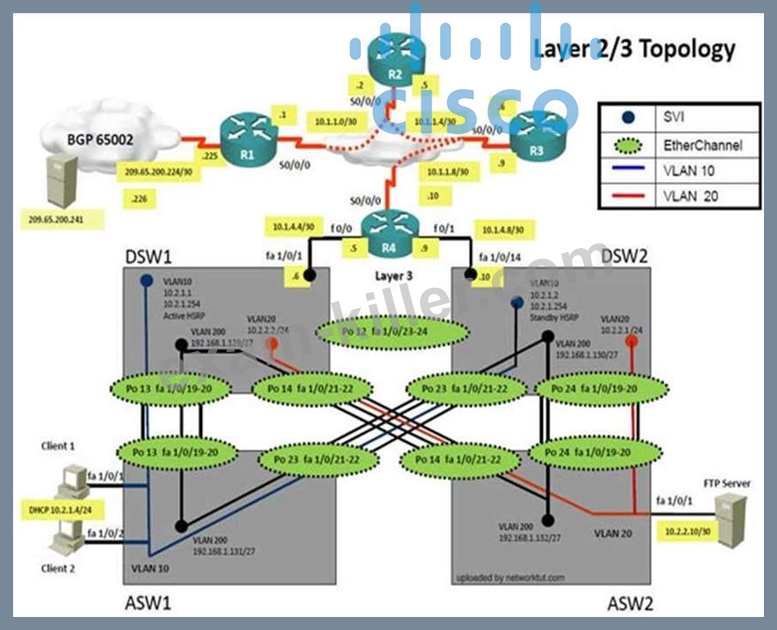
The implementation group has been using the test bed to do a 'proof-of-concept' that requires both Client 1 and Client 2 to access the WEB Server at 209.65.200.241. After several changes to the network addressing, routing schemes, DHCP services, NTP services, and FHRP services, a trouble ticket has been opened indicating that Client 1 cannot ping the 209.65.200.241 address.
Use the supported commands to isolate the cause of this fault and answer the following questions.
The fault condition is related to which technology?
- A. Switch Virtual Interface
- B. VLAN ACL / Port ACL
- C. NTP
- D. Loop Prevention
- E. Switch-to-Switch Connectivity
- F. Access Vlans
- G. Port Security
Answer: E
Explanation:
Steps need to follow as below:-1.When we check on client 1 & Client 2 desktop we are not receiving DHCP address from R4Ipconfig ----- Client will be getting 169.X.X.X2.On ASW1 port Fa1/0/ 1 & Fa1/0/2 access port VLAN 10 was assigned which is using IPaddress 10.2.1.0/24Sh run ------- & check for running config of int fa1/0/1 & fa1/0/2====================================================interface FastEthernet1/0/1switchport mode accessswitchport access vlan 10interface FastEthernet1/0/2switchport mode accessswitchport access vlan 10
3.We need to check on ASW 1 trunk port the trunk Po13 & Po23 were receiving VLAN 20 &200 but not VLAN
10 so that switch could not get DHCP IP address and was failing to reach IPaddress of Internet4.
Change required:
On ASW1 below change is required for switch-to-switch connectivity..int range portchannel13,portchannel23switchport trunk allowed vlan noneswitchport trunk allowed vlan 10,200
NEW QUESTION 32
Which routes does the overlay management protocol advertise in an SD-WAN overlay?
- A. underlay, MPLS, and overlay
- B. primary, backup, and load-balanced
- C. Internet, MPLS, and backup
- D. prefix, TLOC, and service
Answer: D
Explanation:
Explanation/Reference:
NEW QUESTION 33
What are two benefits of designing an SD-WAN network fabric with direct Internet access implemented at every site? (Choose two.)
- A. It increases the speed of delivery of site deployments through zero-touch provisioning.
- B. It decreases latency on Internet circuits.
- C. It decreases latency to applications hosted by public cloud service provider.
- D. It increases the total available bandwidth on Internet circuits.
- E. It alleviates network traffic on MPLS circuits.
Answer: C,E
NEW QUESTION 34
Refer to the exhibit. An engineer is designing an OSPF network for a client. Requirements dictate that the routers in Area 1 should receive all routes belonging to the network, including EIGRP, except the ones originated in the RIP domain. Which action should the engineer take?
- A. Make area 1 a NSSA.
- B. Make the area 1 routers part of area 0.
- C. Make area 1 a standard OSPF area.
- D. Make area 1 a stub.
Answer: A
Explanation: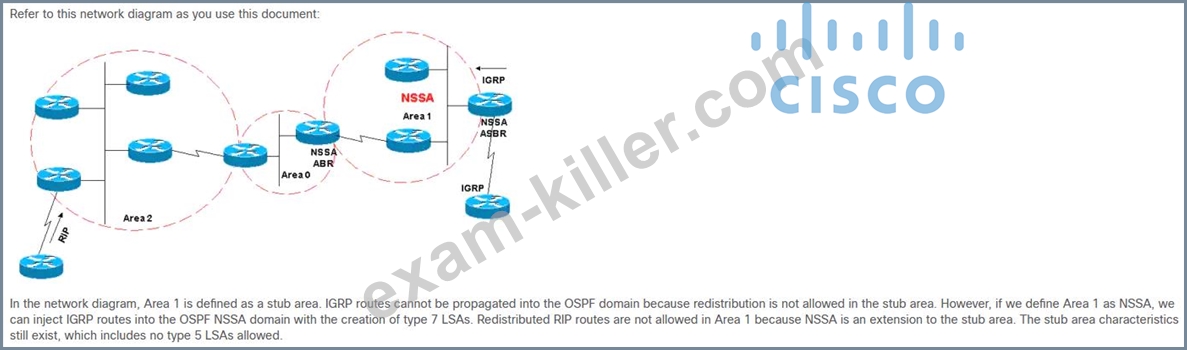
NEW QUESTION 35
Which statements about RSPAN are true? (Choose two.)
- A. RSPAN uses are GRE tunnel to transmit captured traffic.
- B. It supports MAC address learning.
- C. RSPAN VLANS can carry RSPAN traffic only.
- D. MAC address learning is not supported
- E. RSPAN VLANs are exempt from VTP pruning.
- F. only one RSPAN VLAN can be configured per device.
Answer: C,D
Explanation:
The RSPAN VLAN carries SPAN traffic between RSPAN source and destination sessions. It has these special characteristics:
All traffic in the RSPAN VLAN is always flooded.
No MAC address learning occurs on the RSPAN VLAN.
RSPAN VLAN traffic only flows on trunk ports.
RSPAN VLANs must be configured in VLAN configuration mode by using the remote-span VLAN configuration mode command.
STP can run on RSPAN VLAN trunks but not on SPAN destination ports.
An RSPAN VLAN cannot be a private-VLAN primary or secondary VLAN.
For VLANs 1 to 1005 that are visible to VLAN Trunking Protocol (VTP), the VLAN ID and its associated RSPAN characteristic are propagated by VTP. If you assign an RSPAN VLAN ID in the extended VLAN range (1006 to 4094), you must manually configure all intermediate switches.
It is normal to have multiple RSPAN VLANs in a network at the same time with each RSPAN VLAN defining a network-wide RSPAN session. That is, multiple RSPAN source sessions anywhere in the network can contribute packets to the RSPAN session. It is also possible to have multiple RSPAN destination sessions throughout the network, monitoring the same RSPAN VLAN and presenting traffic to the user. The RSPAN VLAN ID separates the sessions.
Reference:
https://www.cisco.com/c/en/us/td/docs/switches/lan/catalyst2960/software/release/12-2_40_se/configuration/ guide/scg/swspan.pdf
NEW QUESTION 36
Which feature is required for graceful restart to recover from a processor failure?
- A. Cisco Express Forwarding
- B. Stateful Switchover
- C. Virtual Switch System
- D. Bidirectional Forwarding Detection
Answer: B
Explanation:
https://archive.nanog.org/meetings/nanog42/presentations/Weissner_SSO.pdf The Stateful Switchover (SSO) feature works with Nonstop Forwarding (NSF) in Cisco software to minimize the amount of time a network is unavailable to its users following a switchover. The primary objective of SSO is to improve the availability of networks constructed with Cisco routers.
NEW QUESTION 37
Refer to the exhibit.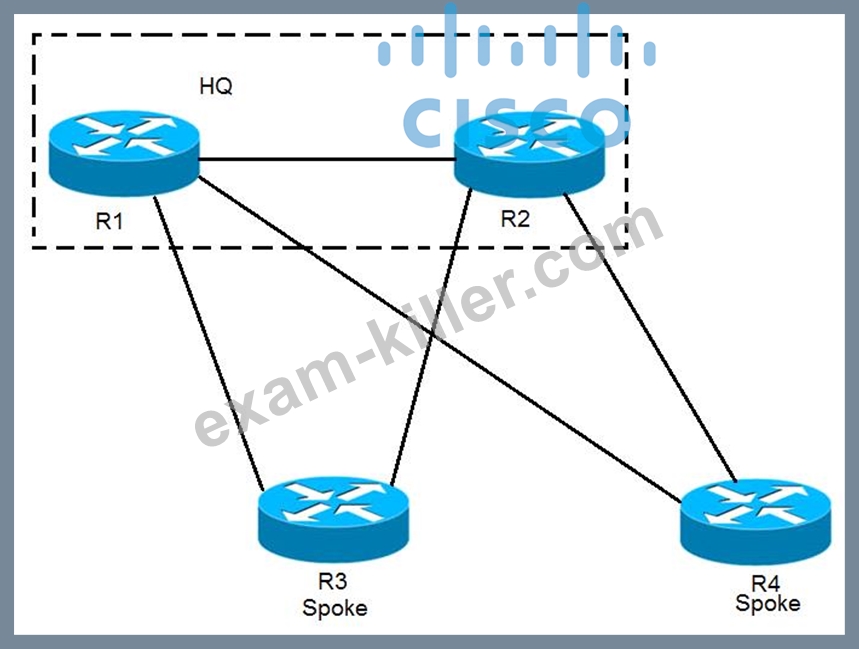
EIGRP has been configured on all links. The spoke nodes have been configured as EIGRP stubs, and the WAN links to R3 have higher bandwidth and lower delay than the links to R4. When a link failure occurs at the R1-R2 link, what happens to traffic on R1 that is destined for a subnet attached to R2?
- A. R1 forwards the traffic to R3, but R3 drops the traffic
- B. R1 forwards the traffic to R3 in order to reach R2
- C. R1 has no route to R2 and drops the traffic
- D. R1 load-balances across the paths through R3 and R4 to reach R2
Answer: B
NEW QUESTION 38
Drag and drop the characteristics from the left onto the telemetry mode they apply to on the right.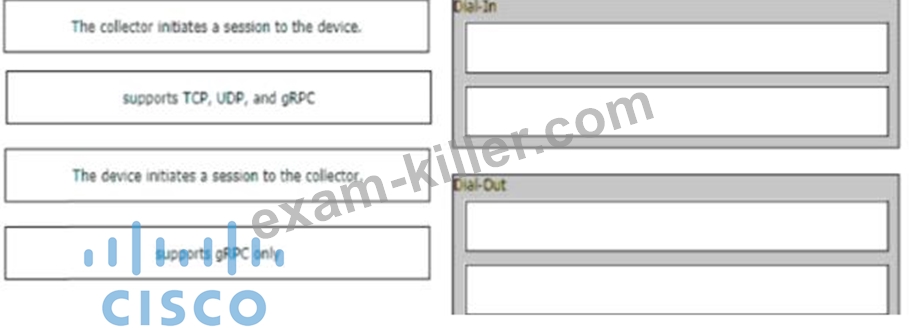
Answer:
Explanation: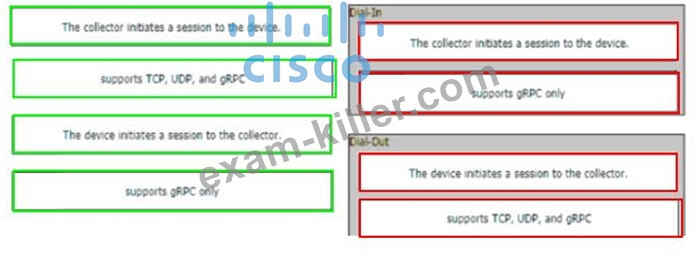
NEW QUESTION 39
In an SD-WAN architecture, which methods are used to bootstrap a vEdge router?
- A. DHCP options or manual configuration
- B. vManage or DNS records
- C. DNS records or DHCP options
- D. ZTP or manual configuration
Answer: D
Explanation:
Section: WAN for Enterprise Networks
NEW QUESTION 40
A customer is discussing QoS requirements with a network consultant. The customer has specified that endto- end path verification is a requirement. Which QoS solution meets this requirement?
- A. DiffServ model with PHB to support the traffic flows
- B. IntServ model with RSVP to support the traffic flows
- C. marking traffic at the access layer with DSCP to support the traffic flows
- D. marking traffic at the access layer with CoS to support the traffic flows
Answer: B
NEW QUESTION 41
An architect is creating a migration strategy for a large organization in which the choice made by the application between IPv6 and IPv4 is based on the DNS request. Which migration strategy does the architect choose?
- A. dual stack
- B. AFT for public web presence
- C. site-to-site IPv6 over IPv4 tunnels
- D. host-initiated tunnels
Answer: A
NEW QUESTION 42
Which technology provides a multichassis IP connection between VSS-enabled switches and downstream devices?
- A. PAgP
- B. LACP
- C. ICCP
- D. LAG
- E. BFD
- F. MEC
Answer: F
NEW QUESTION 43
A network engineer must segregate three interconnected campus networks using IS-IS routing. A two-layer hierarchy must be used to support large routing domains and to avoid more specific routes from each campus network being advertised to other campus network routers automatically. Which two actions does the engineer take to accomplish this segregation? (Choose two.)
- A. Assign the same IS-IS NET value for each campus, and configure internal campus routers with Level 1/ Level 2 routing.
- B. Designate two IS-IS routers as BDR routers at the edge of each campus, and configure one BDR for all Level 1 routers and one BDR for all Level 2 routers.
- C. Utilize different MTU values for each campus network segment. Level 2 backbone routers must utilize a larger MTU size of 9216.
- D. Designate two IS-IS routers from each campus to act as Level 1/Level 2 backbone routers at the edge of each campus network.
- E. Assign a unique IS-IS NET value for each campus, and configure internal campus routers with Level 1 routing.
Answer: D,E
NEW QUESTION 44
Drag and drop the characteristics from the left onto the correct telemetry mode on the right.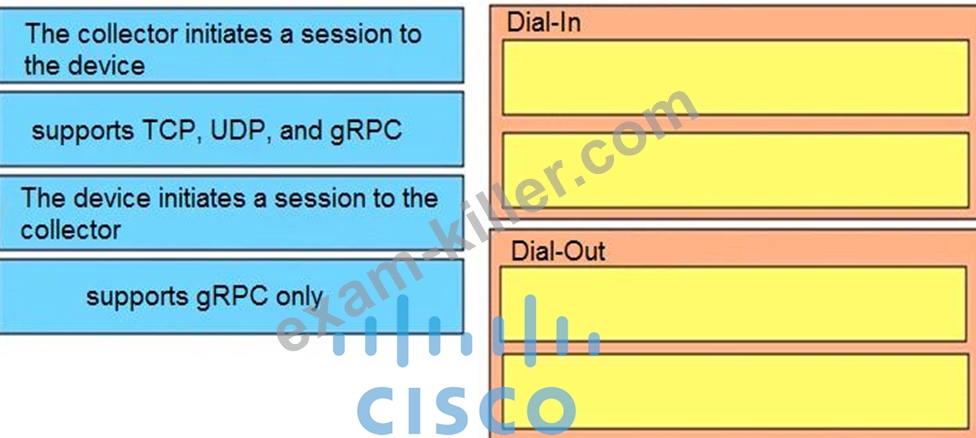
Answer:
Explanation: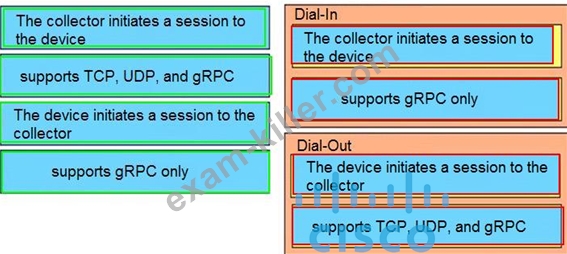
Reference:
https://www.cisco.com/c/en/us/td/docs/iosxr/asr9000/telemetry/b-telemetry-cg-asr9000-61x/b-telemetry-cgasr9000-
61x_chapter_010.html#id_36445
NEW QUESTION 45
Which two BGP features will result in successful route exchanges between eBGP neighbors sharing the same AS number? (Choose two.)
- A. bestpath as-path ignore
- B. client-to-client reflection
- C. advertise-best-external
- D. allow-as-in
- E. as-override
Answer: D,E
Explanation:
Explanation
NEW QUESTION 46
An engineer is working for a large cable TV provider that requires multiple sources streaming video on different channels using multicast with no rendezvous point.
Which multicast protocol meets these requirements?
- A. any-source multicast
- B. PIM-SM
- C. BIDIR-PIM
- D. PIM-SSM
Answer: D
NEW QUESTION 47 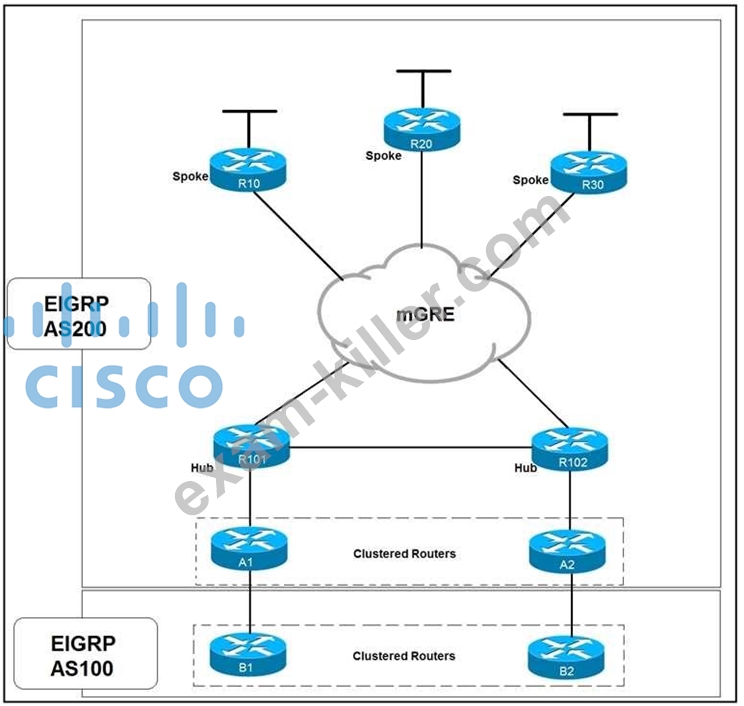
Refer to the exhibit. Which solution decreases the EIGRP convergence time?
- A. Enable subsecond timers
- B. Increase the dead timer value
- C. Enable stub routing on the spokes
- D. Increase the hold time value
Answer: C
NEW QUESTION 48
Which two techniques improve the application experience in a Cisco SD-WAN design? (Choose two.)
- A. utilizing quality of service
- B. utilizing forward error correction
- C. implementing AMP
- D. implementing Cisco Umbrella
- E. implementing a stateful application firewall
Answer: A,B
NEW QUESTION 49
Which two border nodes are available in the Cisco SD-Access architecture? (Choose two.)
- A. anywhere border
- B. internal border
- C. edge border
- D. intermediate border
- E. extended border
Answer: A,E
Explanation:
Section: Advanced Enterprise Campus Networks
NEW QUESTION 50
......
WAN for Enterprise Networks
This topic focuses on 20% of the overall content and validates the applicants’ competence in the following areas:
- Explaining the design considerations for Cisco SD-WAN (LAN design, control plane design, overlay design, scalability, redundancy, high availability, security design, multicast & QoS over the SD-WAN fabric).
- Explaining the architecture for Cisco SD-WAN, including management plane orchestration plan, data plane, security, control plane, provisioning, and on-boarding;
- Designing high availability for enterprise WAN, covering failover, multihomed, backup connectivity, as well as single-homed;
- Comparing the connectivity options for WAN, including MPLS L3 VPN, L2 VPN, 4G/5G, DWDM, Metro Ethernet, and SD-WAN customer edge;
- Designing site-to-site VPN, such as DMVPN, MPLS L3 VPN, L2 VPN, IPsec, GET VPN & GRE;
Cisco 300-420: Selling CCNP Enterprise Products and Solutions: https://pass4sure.exam-killer.com/300-420-valid-questions.html
