

Pass The Open Group OGEA-101 Exam With Practice Test Questions Dumps Bundle
2026 Valid OGEA-101 test answers & The Open Group Exam PDF
NEW QUESTION # 18
Consider the diagram showing a classification model for Architecture Landscapes.
What are the items labelled A, B and C?
- A. A-Capability Architecture, B-Segment Architecture, C-Enterprise Strategic Architecture
- B. A-Strategy Architecture, B-Tactic Architecture, C-Operational Architecture
- C. A-Corporate Capability, B-Portfolio Capability, C-Project Capability
- D. A-Architecture Vision, B-Business Architecture, C-Architecture Development
Answer: A
NEW QUESTION # 19
Complete the sentence. A business scenario describes
- A. shortfalls between the Baseline and Target Architectures
- B. general rules and guidelines for the architecture being developed
- C. business and technology environment in which those problems occur
- D. business domain gaps, such as cross-training requirements
Answer: C
NEW QUESTION # 20
Exhibit: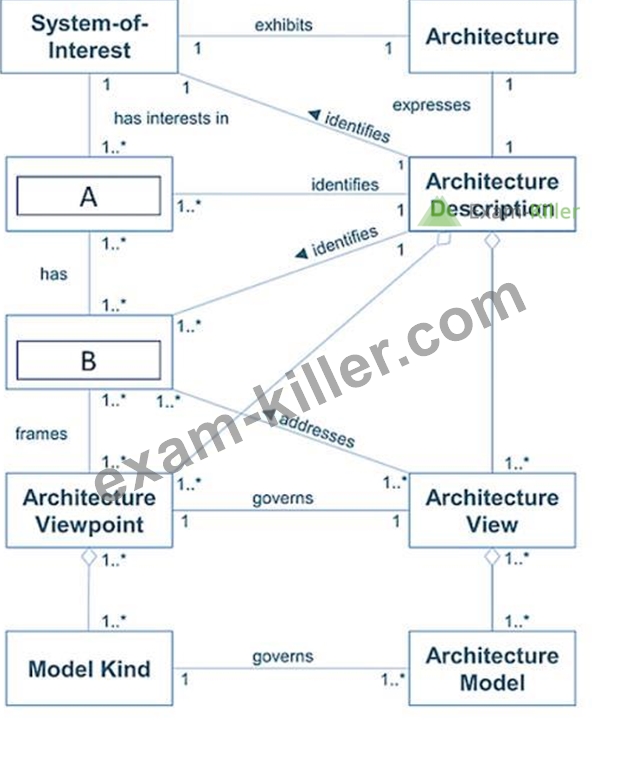
Consider the image showing basic architectural concepts.
What are items A and B?
- A. A-Stakeholder, B-Concern
- B. A-Base Architecture, B-Target Architecture
- C. A-User, B-Requirement
- D. A-Candidate Architecture, B-Trade-off
Answer: A
Explanation:
In the context of TOGAF, a stakeholder is any individual, team, or organization who has interests in, or concerns relative to, the outcome of the architecture. Concerns are those interests which pertain to any aspect of the system's functioning, development or operation, including considerations such as performance, reliability, and security1. References:
*The TOGAF Standard, Version 9.2 - Definitions - The Open Group
NEW QUESTION # 21
What is present in all phases within the ADM and should be identified, classified and mitigated before starting a transformation effort?
- A. Budgetary constraints
- B. Information gaps
- C. Schedule constraints
- D. Risk
Answer: D
Explanation:
According to the TOGAF Standard, 10th Edition, risk is present in all phases within the Architecture Development Method (ADM), and it should be identified, classified, and mitigated before starting a transformation effort 1. Risk is defined as "the effect of uncertainty on objectives" 2, and it can have positive or negative impacts on the architecture project. Risk management is a technique that helps to assess and address the potential risks that may affect the achievement of the architecture objectives, and to balance the trade-offs between opportunities and threats. Risk management is applied throughout the ADM cycle, from the Preliminary Phase to the Requirements Management Phase, and it is integrated with other techniques, such as stakeholder management, business transformation readiness assessment, gap analysis, and migration planning 1. The other options are not correct, as they are not present in all phases within the ADM, and they are not necessarily identified, classified, and mitigated before starting a transformation effort. Budgetary constraints are the limitations on the financial resources available for the architecture project, and they are usually considered in Phase E: Opportunities and Solutions, and Phase F: Migration Planning 3. Schedule constraints are the limitations on the time available for the architecture project, and they are also usually considered in Phase E and F 3. Information gaps are the missing or incomplete data or knowledge that may affect the architecture project, and they are usually identified in Phase B: Business Architecture, Phase C:
Information Systems Architecture, and Phase D: Technology Architecture . References: 1: TOGAF Standard,
10th Edition, Part III: ADM Guidelines and Techniques, Chapter 32: Risk Management. 2: TOGAF Standard,
10th Edition, Part I: Introduction, Chapter 3: Definitions. 3: TOGAF Standard, 10th Edition, Part II:
Architecture Development Method, Chapter 16: Phase E: Opportunities and Solutions, and Chapter 17: Phase F: Migration Planning. : TOGAF Standard, 10th Edition, Part II: Architecture Development Method, Chapter
13: Phase B: Business Architecture, Chapter 14: Phase C: Information Systems Architecture, and Chapter 15:
Phase D: Technology Architecture.
NEW QUESTION # 22
Which of the following best describes the TOGAF Architecture Development Method?
- A. A technique to assess readiness for change.
- B. A process for managing architecture requirements.
- C. A repeatable process for developing architectures.
- D. A classification mechanism for architectures and solutions.
Answer: C
Explanation:
The TOGAF Architecture Development Method (ADM) is best described as a repeatable process for developing architectures. It provides the step-by-step method used to create, evolve, govern, and manage enterprise architectures in a consistent and structured way. The ADM is the core of TOGAF and defines how architecture work progresses from preparation and vision through business, data, application, and technology architecture, then into opportunities, migration planning, implementation governance, and change management.
Option A is incorrect because a classification mechanism is not the purpose of the ADM. Option B is too narrow, since requirements management is only one supporting aspect of the ADM, not its full definition.
Option C is also incorrect because readiness assessment may be used as a technique within architecture practice, but it is not what the ADM itself is.
The strength of the ADM is that it is iterative, adaptable, and repeatable. It can be tailored for different enterprises and change scenarios while still preserving a consistent method. This makes it suitable for both large transformation efforts and more focused architecture initiatives. Therefore, the best description is option D, a repeatable process for developing architectures.
NEW QUESTION # 23
Which of the following statements about architecture partitioning is correct?
- A. Partitions are defined and assigned to agile Enterprise Architecture teams.
- B. Partitions reflect the organization's structure.
- C. Partitions are used to simplify the management of the Enterprise Architecture.
- D. Partitions are equivalent to architecture levels.
Answer: C
Explanation:
Based on the web search results, architecture partitioning is a technique that divides the Enterprise Architecture into smaller and manageable segments or groups, based on various classification criteria, such as subject matter, time, maturity, volatility, etc.12 Architecture partitioning is used to simplify the development and management of the Enterprise Architecture, by reducing complexity, improving governance, enhancing reusability, and increasing alignment and agility12. Therefore, the statement that partitions are used to simplify the management of the Enterprise Architecture is correct.
The other statements are incorrect because:
*Partitions are not equivalent to architecture levels. Architecture levels are different layers of abstraction that describe the Enterprise Architecture from different perspectives, such as strategic, segment, and capability3.
Partitions are subsets of architectures that are defined within or across the levels, based on specific criteria1.
*Partitions do not necessarily reflect the organization's structure. The organization's structure is one possible criterion for partitioning the architecture, but it is not the only one. Other criteria, such as business function, product, service, geography, etc., can also be used to partition the architecture12.
*Partitions are not defined and assigned to agile Enterprise Architecture teams. Agile Enterprise Architecture is an approach that applies agile principles and practices to the architecture work, such as iterative development, frequent feedback, adaptive planning, and continuous delivery4. Partitions are not a specific feature of agile Enterprise Architecture, but a general technique that can be applied to any architecture method or framework, including TOGAF12.
NEW QUESTION # 24
Complete the sentence. The architecture domains that are considered by the TOGAF standard as subsets of an overall enterprise architecture are Business, Technology,
- A. Application and Data
- B. Logical and Physical
- C. Capability and Segment
- D. Information and Data
Answer: A
Explanation:
These domains provide a consistent way to describe and understand the architecture from different perspectives, such as business, information, and technology12. Each domain has its own set of concepts, models, views, and artifacts that define the structure and behavior of the architecture within that domain12.
The other options are incorrect because:
* Logical and Physical are not architecture domains, but rather levels of abstraction that can be applied to any domain. Logical architecture describes the functionality and behavior of the system, while physical architecture describes the implementation and deployment of the system3.
* Information and Data are not distinct architecture domains, but rather aspects of the same domain. Information architecture describes the meaning and context of the data, while data architecture describes the structure and format of the data4.
* Capability and Segment are not architecture domains, but rather levels of granularity that can be applied to any domain. Capability architecture describes the current and desired states of a specific business capability, while segment architecture describes a subdivision of the enterprise that has a clear business focus5.
NEW QUESTION # 25
Which of the following statements about architecture partitioning are correct*?
1 Partitions are used to simplify the management of the Enterprise Architecture
2 Partitions are equivalent to architecture levels
3 Partitions enable different teams to work on different element of the architecture at the same time.
4 Partitions reflect the organization's structure
- A. 1 & 3
- B. 2 & 4
- C. 2 & 3
- D. 1 & 4
Answer: A
Explanation:
Statements 1 and 3 about architecture partitioning are correct. Architecture partitioning is the technique of dividing an architecture into smaller and more manageable parts that can be developed, maintained, and governed independently. Partitions are used to simplify the management of the Enterprise Architecture and to enable different teams to work on different elements of the architecture at the same time. Partitions are not equivalent to architecture levels, which are different degrees of abstraction or detail in an architecture. Partitions do not necessarily reflect the organization's structure, which may change over time or differ from the architecture's scope and boundaries. Reference: The TOGAF Standard | The Open Group Website, Section 2.5 Architecture Partitioning.
NEW QUESTION # 26
Consider the following statements:
1. Groups of countries, governments, or governmental organizations (such as militaries) working together to create common or shareable deliverables or infrastructures
2. Partnerships and alliances of businesses working together, such as a consortium or supply chain What are those examples of according to the TOGAF Standard?
- A. Enterprises
- B. Architectures Scopes
- C. Organizations
- D. Business Units
Answer: B
Explanation:
According to the TOGAF standard, the two statements provided refer to different scopes within which architecture can be developed:
1.Groups of countries, governments, or governmental organizations working together typically align with broader, often international, scopes of architecture that transcend individual enterprise boundaries.
1.Partnerships and alliances of businesses working together, such as a consortium or supply chain, refer to collaborative efforts that can define architecture at a scope involving multiple enterprises.
In both cases, the term "Architectures Scopes" is appropriate because it reflects the varying levels and contexts in which architectures can be defined, ranging from single business units to collaborative inter-organizational efforts.
NEW QUESTION # 27
Which of the following are interests important to the stakeholders in a system?
- A. Concerns
- B. Requirements
- C. Principles
- D. Architecture views
Answer: A
Explanation:
Concerns are interests important to the stakeholders in a system. They are used to identify and classify the system's stakeholders and to guide the selection of viewpoints for the architecture description. Reference: The TOGAF Standard | The Open Group Website, Section 3.2.1 Architecture Viewpoints
NEW QUESTION # 28
Which section of the TOGAF template for Architecture Principles should highlight the requirements for carrying out the principle?
- A. Statement
- B. Name
- C. Implications
- D. Rationale
Answer: C
Explanation:
The Implications section describes the impact of adhering to the principle on the organization, the processes, the information systems, and the technology23. It also identifies the changes, costs, and risks that may result from applying the principle23. The Implications section helps to communicate the benefits and consequences of the principle to the stakeholders and to guide the implementation and governance of the architecture23.
The other sections of the TOGAF template for Architecture Principles are1:
*Name: This section provides a short and memorable name for the principle that represents its essence and purpose23. The name should not mention any specific technology or solution23.
*Statement: This section provides a concise and formal definition of the principle that expresses the fundamental rule or constraint that the principle imposes23. The statement should be clear, unambiguous, and testable23.
*Rationale: This section provides the reasoning and justification for the principle, explaining why it is important and how it supports the business goals and drivers23. The rationale should also link the principle to the higher-level enterprise or IT principles that it elaborates on23.
References: 2: The TOGAF Standard, Version 9.2 - Architecture Principles 3: TOGAF 8.1.1 Online - Architecture Principles 1: Architecture Principles Template
NEW QUESTION # 29
Consider the following statements.
1. All processes, decision-making, and mechanisms used will be established so as to minimize or avoid potential conflicts of interest.
2. More effective strategic decision-making will be made by C-Level executives and business leaders.
3. All actions implemented and their decision support will be available for inspection by authorized organization and provider parties.
4. Digital Transformation and operations will be more effective and efficient.
Which statements highlight the value and necessity for Architecture Governance to be adopted within organizations?
- A. 1 & 3
- B. 2 & 4
- C. 1 & 4
- D. 2& 3
Answer: A
Explanation:
Statements 1 and 3 highlight the value and necessity for Architecture Governance to be adopted within organizations. Architecture Governance is the practice and orientation by which Enterprise Architectures and other architectures are managed and controlled at an enterprise-wide level12. It ensures that architectural decisions are aligned with the organization's strategy, objectives, and standards. Architecture Governance also involves establishing and maintaining processes, decision-making, and mechanisms to avoid or minimize potential conflicts of interest, such as between different stakeholders, business units, or projects34. Moreover, Architecture Governance requires transparency and accountability for all actions implemented and their decision support, so that they can be inspected and evaluated by authorized parties, such as auditors, regulators, or customers5 . Reference:
* The TOGAF Standard, Version 9.2 - Architecture Governance - The Open Group
* Architecture Governance - The Open Group
* Tutorial: Governance in TOGAF's Architecture Development Method (ADM)
* Architecture Governance in TOGAF: Ensuring Effective Management and Compliance
* The TOGAF Standard, Version 9.2 - Definitions - The Open Group
* [Architecture Governance in TOGAF: Ensuring Alignment and Control]
NEW QUESTION # 30
Consider the following descriptions of deliverables consumed and produced across the TOGAF ADM cycle.
General rules and guidelines, intended to be enduring and seldom
amended, that inform and support the way in which an organization sets
about fulfilling its mission
The joint agreements between development partners and sponsors on the
deliverables, quality, and fitness-for-purpose of an architecture.
A document that is sent from the sponsoring organization to the
architecture organization to trigger the start of an architecture
development cycle
A set of quantitative statements that outline what an implementation
project must do in order to comply with the architecture.
Which deliverables match these descriptions?
- A. 1 Architecture Principles -2 Architecture Contracts - 3 Request for Architecture Work - 4 Architecture Requirements Specification
- B. 1 Architecture Contracts - 2 Architecture Requirements Specification - 3 Architecture Vision - 4 Architecture Principles
- C. 1 Architecture Requirements Specification -2 Architecture Principles - 3 Architecture Vision - 4 Architecture Contracts
- D. 1 Architecture Principles -2 Architecture Contracts - 3 Architecture Requirements Specification-4 Request for Architecture Work
Answer: A
Explanation:
According to the TOGAF standard, the deliverables that match the descriptions are as follows:
1 Architecture Principles: These are general rules and guidelines, intended to be enduring and seldom amended, that inform and support the way in which an organization sets about fulfilling its mission1. They reflect a level of consensus among the various elements of the enterprise, and form the basis for making future IT decisions1.
2 Architecture Contracts: These are the joint agreements between development partners and sponsors on the deliverables, quality, and fitness-for-purpose of an architecture2. They are used to ensure that the architecture is implemented and governed according to the agreed-upon specifications and standards2.
3 Request for Architecture Work: This is a document that is sent from the sponsoring organization to the architecture organization to trigger the start of an architecture development cycle3. It defines the scope, schedule, budget, deliverables, and stakeholders of the architecture project3.
4 Architecture Requirements Specification: This is a set of quantitative statements that outline what an implementation project must do in order to comply with the architecture4. It defines the requirements for each architecture domain, as well as the relationships and dependencies among them4.
NEW QUESTION # 31
What are the four dimensions used to scope an architecture?
- A. Strategy Segment Capability Budget
- B. Strategy Portfolio Project Solution Delivery
- C. Breadth Depth Time Period Architecture Domains
- D. Business Data Application Technology
Answer: C
Explanation:
* The four dimensions used to scope an architecture are Breadth, Depth, Time Period, and Architecture Domains1, p. 8.
* Breadth refers to the extent of the enterprise covered by the architecture, which can range from a specific business unit to the entire organization1, p. 8.
* Depth refers to the level of detail and completeness of the architecture, which can vary depending on the purpose, scope, and stakeholders of the architecture1, p. 8.
* Time Period refers to the temporal aspects of the architecture, such as the current state, the target state, and the transition plan1, p. 8.
* Architecture Domains refers to the classification of the architecture into four domains: Business, Data, Application, and Technology1, p. 8.
* These four dimensions help define the scope and boundaries of the architecture and ensure that it meets the needs and expectations of the stakeholders.
NEW QUESTION # 32
Complete the following sentence:
Presenting different_________and_________to stakeholders helps architects to extract hidden agendas principles and requirements that could impact the final Target Architecture
- A. Architecture Views Architecture Viewpoints
- B. Solutions Applications
- C. Business Scenarios Business Models
- D. Alternatives Trade-offs
Answer: A
Explanation:
According to the TOGAF Standard, an architecture view is a representation of a system from the perspective of a related set of concerns1. An architecture viewpoint is a specification of the conventions for a particular kind of architecture view1. Presenting different architecture views and architecture viewpoints to stakeholders helps architects to extract hidden agendas, principles, and requirements that could impact the final target architecture. This is because different stakeholders may have different concerns and interests in the system, and by showing them how the system addresses their concerns from different perspectives, the architects can elicit more feedback and validation from them2. For example, a business stakeholder may be interested in the business architecture view, which focuses on the business processes, functions, and capabilities of the system3. A security stakeholder may be interested in the enterprise security view, which addresses the security aspects of the system, such as confidentiality, integrity, and availability3. By presenting these views to the respective stakeholders, the architects can ensure that the system meets their expectations and needs, and also identify any potential issues or gaps that may affect the target architecture. References: 1: The TOGAF Standard, Version 9.2 - Architectural Artifacts - TheOpen Group1; 2: Understanding TOGAF Views and Viewpoints in Enterprise Architecture2; 3: Developing Architecture Views - The Open Group4
NEW QUESTION # 33
Consider the following ADM phases objectives.
Which phase does each objective match?
- A. 1E-2F-3E-4F
- B. 1G-2E-3F-4F
- C. 1F-2E-3F-4G
- D. 1E-2E-3F-4F
Answer: B
NEW QUESTION # 34
Which statement best summarizes the TOGAF Content Framework?
- A. It provides lifecycle management capabilities to create and manage architectures.
- B. It is organized based on the phases of ADM.
- C. It shows the detailed relationships and interactions between information entities.
- D. It is fixed and should not be changed or modified.
Answer: C
Explanation:
* The TOGAF Content Framework defines a detailed model of architectural work products (artifacts, deliverables, building blocks) and the relationships between them.
* It is not a lifecycle management capability (A), that is related to the ADM itself.
* It is not organized strictly by ADM phases (B).
* It is not fixed; it is designed to be tailored (C).
Reference: TOGAF Standard, Version 9.2, Part IV: Architecture Content Framework.
NEW QUESTION # 35
In which part of the ADM cycle do building block gaps become associated with work packages that will address the gaps?
- A. Phase E
- B. Phases F
- C. Phases G and H
- D. Phases B C and D
Answer: A
Explanation:
The TOGAF ADM uses Gap Analysis during Phases B, C, and D (Business, Information Systems, and Technology Architectures) to identify building block gaps-the differences between the Baseline Architecture and the Target Architecture. However, simply identifying gaps does not complete the process.
The association of gaps with work packages happens later in the cycle:
* Phase E: Opportunities and Solutions is where the identified gaps are analyzed and translated into work packages, projects, or initiatives that will deliver the required changes.
* In Phase E, architects also determine whether Transition Architectures are needed, and they generate the initial Architecture Roadmap.
* This is the phase where gaps become actionable, linked with specific work packages that can be executed to close them.
Phase F (Migration Planning) takes this further by finalizing the roadmap and building the detailed Implementation and Migration Plan, but the initial association of gaps with work packages occurs in Phase E.
NEW QUESTION # 36
Which of the following is the application of the concepts of risk assessment and risk analysis in the decision- making process?
- A. Risk Management
- B. Security Architecture
- C. Information Security Management
- D. Security Governance
Answer: A
Explanation:
The correct answer is Risk Management because risk assessment and risk analysis are core parts of the risk management process. In TOGAF, risk management is used to support architectural and implementation decision-making by identifying risks, evaluating their likelihood and impact, and determining appropriate responses. This allows stakeholders and architects to make informed choices about architecture options, transition paths, implementation timing, and governance actions.
Risk assessment focuses on understanding the nature of identified risks and estimating their significance. Risk analysis examines those risks in more detail to determine consequences, priorities, and possible treatments.
These activities are not stand-alone disciplines in TOGAF; they are applied as part of Risk Management, which provides the structured method for using risk information in decisions.
The other options are related but not as precise. Information Security Management focuses on managing security controls and policies. Security Governance is concerned with oversight and accountability. Security Architecture defines structural security capabilities and controls. While all may use risk-related information, the direct application of risk assessment and risk analysis in decision-making belongs to Risk Management.
Therefore, according to TOGAF terminology and governance practice, the best answer is C.
NEW QUESTION # 37
In which phase of the ADM cycle do building blocks become implementation-specific?
- A. Phase C
- B. Phase E
- C. Phase B
- D. Phase D
Answer: B
Explanation:
Building blocks are reusable components of business, IT, or architectural capability that can be combined to deliver architectures and solutions. Building blocks can be defined at various levels of detail, depending on the stage of architecture development. In the earlier phases of the ADMcycle (A to D), building blocks are defined in generic terms, such as logical or physical, to provide a high-level view of the architecture. In Phase E: Opportunities and Solutions, building blocks become implementation-specific, meaning that they are linked to specific products, standards, technologies, and vendors that are available in the market. This phase also identifiesthe delivery vehicles, such as projects, programs, or portfolios, that will realize the building blocks12 References: 1: The TOGAF Standard, Version 9.2, Part II: Architecture Development Method (ADM), Chapter 23: Phase E: Opportunities and Solutions 2: The TOGAF Standard, Version 9.2, Part IV:
Architecture Content Framework, Chapter 36: Building Blocks
NEW QUESTION # 38
Which of the following is a responsibility of an Architecture Board?
- A. Creating the Statement of Architecture Work
- B. Conducting assessments of the maturity level of architecture discipline within the organization
- C. Establishing targets for re-use of components
- D. Allocating resources for architecture projects
Answer: C
Explanation:
An Architecture Board is an executive-level group responsible for the review and maintenance of the strategic architecture and all of its sub-architectures1. It is a key element in a successful Architecture Governance strategy2.
An Architecture Board is typically made responsible, and accountable, for achieving some or all of the following goals2:
Providing the basis for all decision-making with regard to the architectures Consistency between sub-architectures Establishing targets for re-use of components Flexibility of the Enterprise Architecture: To meet changing business needs To leverage new technologies Enforcement of Architecture Compliance Improving the maturity level of architecture discipline within the organization Ensuring that the discipline of architecture-based development is adopted Supporting a visible escalation capability for out-of-bounds decisions Therefore, the correct answer is option D, which captures one of the goals of an Architecture Board as stated in the TOGAF Standard, Version 9.22.
Option A is incorrect, because conducting assessments of the maturity level of architecture discipline within the organization is not a direct responsibility of an Architecture Board, but rather a part of the Architecture Capability Framework3.
Option B is incorrect, because allocating resources for architecture projects is not a direct responsibility of an Architecture Board, but rather a part of the Architecture Governance Framework4.
Option C is incorrect, because creating the Statement of Architecture Work is not a direct responsibility of an Architecture Board, but rather a part of the Architecture Development Method5. Reference:
1: Architecture Board - The Open Group3
2: TOGAF Standard, Version 9.2 - Part VI: Architecture Governance Framework - Architecture Board
3: TOGAF Standard, Version 9.2 - Part VI: Architecture Governance Framework - Architecture Capability Framework
4: TOGAF Standard, Version 9.2 - Part VI: Architecture Governance Framework - Architecture Governance Framework
5: TOGAF Standard, Version 9.2 - Part II: Architecture Development Method - Phase A: Architecture Vision
NEW QUESTION # 39
......
The Open Group OGEA-101 Exam Syllabus Topics:
| Topic | Details |
|---|---|
| Topic 1 |
|
| Topic 2 |
|
| Topic 3 |
|
| Topic 4 |
|
| Topic 5 |
|
| Topic 6 |
|
| Topic 7 |
|
| Topic 8 |
|
| Topic 9 |
|
Top The Open Group OGEA-101 Courses Online: https://pass4sure.exam-killer.com/OGEA-101-valid-questions.html
