

[Jun 12, 2026] Verified PK0-005 dumps and 448 unique questions
PK0-005 Dumps for Pass Guaranteed - Pass PK0-005 Exam 2026
CompTIA PK0-005 exam is ideal for professionals who want to start a career in project management or those who want to enhance their existing skills. CompTIA Project+ Certification Exam certification is recognized globally and is a valuable addition to any professional's resume. It demonstrates to potential employers that the candidate has the knowledge and skills required to manage projects successfully.
CompTIA Project+ Certification exam is a challenging exam that requires preparation and dedication. PK0-005 exam consists of 95 multiple-choice and performance-based questions, and candidates are given 90 minutes to complete the exam. PK0-005 exam is available in various languages, including English, Japanese, Portuguese, and Spanish. The CompTIA PK0-005 certification exam is an excellent way for professionals to demonstrate their project management skills and knowledge, which can lead to better job opportunities and career growth.
NEW QUESTION # 33
While working in a collaborative, online brainstorming session, team members send private messages to the
facilitator about challenges understanding others when they are speaking due to accents and background
noises. Which of the following should the facilitator do to overcome the challenges?
- A. Encourage the use of the chat and use plain language when speaking.
- B. Allow one person to speak at a time after receiving acknowledgment from the facilitator.
- C. Instruct the team members to set their speakers to maximum volume and mute their microphones.
- D. Require everyone to turn on their cameras and use the same background filter.
Answer: A
Explanation:
Using the chat and plain language can help overcome the communication barriers caused by accents and
background noises. Chat allows team members to write down their ideas and questions, which can be easier to
understand than spoken words. Plain language reduces the ambiguity and complexity of the messages, making
them more clear and concise. These techniques can also enhance the participation and engagement of the team
members, as they can express their thoughts and opinions more comfortably and confidently. References =
CompTIA Project+ Study Guide: Exam PK0-005, 3rd Edition, Chapter 4: Communication and Change
Management, p. 97-98.
NEW QUESTION # 34
While managing a project, a PM is assigned to work on a second project. The second project becomes more complex and monopolizes the PM's time. The PM learns that a similarly time-consuming project was executed previously in the organization. Which of the following actions should the PM take?
- A. Perform a root cause analysis.
- B. Organize a stakeholder meeting
- C. Contact the PMO for assistance.
- D. Escalate the issue to the CCB
Answer: C
Explanation:
Explanation
The project manager should contact the project management office (PMO) for assistance after learning that a similarly time-consuming project was executed previously in the organization. A PMO is a department or group within an organization that provides centralized guidance, governance, standards, best practices, resources, and oversight for project managementactivities. A PMO can help the project manager by providing access to historical data, lessons learned, templates, tools, methodologies, and expertise from previous projects that can be useful for planning and executing the current project.
NEW QUESTION # 35
In a functional organization, a project has been completed successfully. Which of the following actions would the project manager MOST likely perform?
- A. Allocate resources in a different project
- B. Assemble a new project with existing resources.
- C. Notify the functional manager that resources are released.
- D. Obtain the final report from release management.
Answer: C
Explanation:
Explanation
The project manager should notify the functional manager that resources are released after completing a project successfully in a functional organization. A functional organization is a type of organizational structure where employees are grouped by their functions or specialties, such as finance, marketing, or engineering. In a functional organization, the functional manager has more authority and control over the resources than the project manager. Therefore, the project manager should inform the functional manager when the resources are no longer needed for the project and can be reassigned to other tasks or projects.
NEW QUESTION # 36
During the project initiation phase, a project team has been identified. Which of the following is the NEXT step for the project manager?
- A. Create a project schedule
- B. Determine budget constraints.
- C. Validate the business case.
- D. Update the project charter.
Answer: D
Explanation:
Explanation
Update the project charter. Updating the project charter would be the next step for the project manager after identifying the project team during the project initiation phase. A project charter is a document that formally authorizes a project and defines its purpose, scope, objectives, deliverables, milestones, roles and responsibilities, assumptions, constraints, risks, budget, and timeline. A project charter can help to align the expectations and interests of all stakeholders involved in a project and provide direction and guidance for planning and executing the project.
NEW QUESTION # 37
Which of the following provides a layered approach to logging in to systems that contain an organization's most valuable intellectual property?
- A. Password protection
- B. Virtual private network
- C. Multifactor authentication
- D. Remote access
Answer: C
Explanation:
Multifactor authentication (MFA) is a security method that requires users to provide two or more pieces of evidence to verify their identity before accessing a system. MFA can use different types of factors, such as something the user knows (e.g., password, PIN, security question), something the user has (e.g., token, smart card, mobile device), or something the user is (e.g., fingerprint, face, voice). MFA provides a layered approach to logging in to systems that contain an organization's most valuable intellectual property, as it makes it harder for unauthorized users to gain access by compromising one factor alone. MFA can also prevent phishing, brute force, and credential theft attacks12. References = CompTIA Project+ PK0-005 Certification Study Guide,
NEW QUESTION # 38
Which of the following cloud models is designed to provide compute, storage, and networking resources on demand?
- A. Platform as a service
- B. Software as a service
- C. Data as a service
- D. Infrastructure as a service
Answer: D
Explanation:
Infrastructure as a service (IaaS) is a cloud model that provides on-demand access to cloud-hosted physical and virtual servers, storage, and networking resources. IaaS customers can provision, configure, and use these resources as they would use on-premises hardware, but without the hassle of purchasing, installing, managing, and maintaining them. The cloud service provider owns, manages, and maintains the hardware and computing resources in its own data centers, and charges the customers based on their usage. IaaS is suitable for customers who need flexibility, scalability, and control over their IT infrastructure, and who want to avoid the high costs and complexity of owning and operating their own hardware. The other options are not correct because:
Software as a service (SaaS) is a cloud model that provides on-demand access to ready-to-use, cloud-hosted application software. SaaS customers do not need to install, update, or maintain the software, as the cloud service provider handles all the technical aspects. SaaS is suitable for customers who need to access common applications, such as email, office productivity, or customer relationship management, without worrying about the underlying infrastructure or platform.
Data as a service (DaaS) is a cloud model that provides on-demand access to cloud-hosted data sources, such as databases, data warehouses, or data lakes. DaaS customers can query, analyze, and visualize the data, as well as integrate it with other applications or services, using APIs or web interfaces. DaaS is suitable for customers who need to leverage data from various sources, such as social media, IoT devices, or third-party providers, without having to store, manage, or process the data themselves.
Platform as a service (PaaS) is a cloud model that provides on-demand access to a complete, ready-to-use, cloud-hosted platform for developing, running, maintaining, and managing applications.
PaaS customers can use the platform's tools, frameworks, libraries, and services to create and deploy applications, without having to worry about the underlying infrastructure or software. PaaS is suitable for customers who need to develop, test, and deploy applications quickly and efficiently, and who want to take advantage of the cloud's scalability, reliability, and security features. References = IaaS vs. PaaS vs. SaaS; AWS Fundamentals: Understanding Compute, Storage, Database, Networking & Security; What are the different types of cloud computing?; What is Cloud Storage and How to Use It
NEW QUESTION # 39
During a quality analysis review, the causes of several issues have been highlighted. Which of the following should the project manager use to identify the MOST important causes?
- A. Scatter diagram
- B. Ishikawa diagram
- C. Pareto chart
- D. Decision tree
Answer: C
Explanation:
The Pareto chart should be used to identify the most important causes of issues during a quality analysis review. The Pareto chart is a graphical representation of the frequency and impact of different causes, helping to identify the most common and impactful causes. References: CompTIA Project+ Study Guide Section 3.3.3
NEW QUESTION # 40
A stakeholder raises a concern with a project manager because of the number of emails that have been received before a coding release. Which of the following actions should the project manager take next?
- A. Revise the communication plan.
- B. Inform the CCB to stop communication.
- C. Establish a RACI matrix.
- D. Escalate the communication issues.
Answer: A
Explanation:
When stakeholders express concerns about the volume of communication, it's important to review and adjust the communication plan to ensure it meets the project's needs and stakeholders' preferences. A RACI matrix is useful for defining roles and responsibilities but does not address communication frequency or methods directly. Escalating the issue may not be necessary if it can be resolved by revising the plan. Informing the CCB (Change Control Board) to stop communication is not advisable as the CCB's role is to oversee changes, not to manage day-to-day communications. Reference = The CompTIA Project+ Certification Study Guide provides detailed information on managing the project life cycle, establishing communication plans, and handling stakeholder concerns1.
NEW QUESTION # 41
A project manager buys an extended warranty for a set of servers. Which of the following risk management strategies is the manager using?
- A. Avoid
- B. Accept
- C. Transfer
- D. Mitigate
Answer: C
Explanation:
Transfer is a risk management strategy that involves shifting the responsibility or impact of a risk to a third party, such as an insurance company, a vendor, or a contractor1. By buying an extended warranty for a set of servers, the project manager is transferring the risk of server failure or malfunction to the warranty provider, who will cover the cost of repair or replacement in case of a risk event. This way, the project manager reduces the exposure and liability of the project to the risk, while still retaining some level of accountability and oversight2. References = CompTIA Project+ PK0-005 Certification Study Guide, Chapter 8: Planning Projects Part 4, page 245; 4 Risk Management Strategies for Successful Project Execution, Risk transferring section; How to Manage Project Risk: A 5-Step Guide, Risk treatment section.
NEW QUESTION # 42
Which of the following software programs would be best to use to store information related to business transactions?
- A. Content management system
- B. Record management system
- C. Enterprise resource planning
- D. Customer relationship management
Answer: C
Explanation:
Enterprise resource planning (ERP) software is a type of software that integrates various business functions and processes, such as accounting, finance, inventory, sales, purchasing, human resources, and more. ERP software helps businesses store, organize, and manage information related to business transactions, such as invoices, payments, orders, receipts, and reports. ERP software also provides real-time data analysis, reporting, and forecasting capabilities12.
NEW QUESTION # 43
The high-level technical requirements for a new application state that the application should be suitable to support enterprise-level client-server solutions. Which of the following meets these requirements?
- A. Content management system
- B. SQL database
- C. Multitier architecture
- D. Data warehouse
Answer: C
Explanation:
Explanation
Multitier architecture is a type of software architecture that is suitable to support enterprise-level client-server solutions. Multitier architecture divides an application into logical layers or tiers that are distributed among different servers or machines. Each tier performs a specific function or role and communicates with other tiers through well-defined interfaces. Multitier architecture can provide benefits such as scalability, performance, security, maintainability, and reusability for complex and large-scale applications.
NEW QUESTION # 44
A PM is working to establish accepted communication channels and to define access requirements. In which of the following phases is the project?
- A. Execution
- B. Discovery
- C. Initiating
- D. Planning
Answer: D
Explanation:
Defining communication channels and access requirements typically occurs in the planning phase, where detailed plans for project management are established. This aligns with CompTIA Project+ standards for comprehensive project planning.
NEW QUESTION # 45
A project manager realizes that a project will not be completed on time due to resource constraints. Which of the following actions should the project manager take NEXT?
- A. Transfer the risk by hiring a new vendor who was successful on a previous project.
- B. Submit a change request to the change control board.
- C. Work with the functional managers to create a work-around.
- D. Trigger the contingency plan and communicate with the stakeholders.
- E. Set up an escalation meeting with the sponsor.
Answer: B
Explanation:
Submit a change request to the change control board. The project manager should submit a change request to the change control board (CCB) if they realize that the project will not be completed on time due to resource constraints. A change request is a formal proposal to modify any aspect of the project, such as scope, schedule, cost, quality, or resources. A change request must be submitted to the CCB, which is a group of stakeholders who are authorized to review and approve changes. Submitting a change request can help to document the impact of the resource constraints on the project and seek approval for any corrective actions or preventive actions12
NEW QUESTION # 46 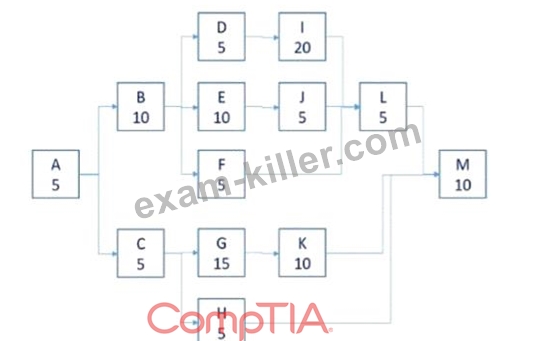
Given the following network diagram:
Which of the following is the critical path?
- A. A-B-F-L-M
- B. A-C-G-K-M
- C. A-B-E-J-L-M
- D. A-B-D-l-L-M
Answer: B
Explanation:
The critical path is the sequence of tasks that determines the minimum project duration. It is the longest path
through the network diagram and has the least amount of slack or float. Based on the provided network
diagram, the critical path is A-C-G-K-M, which has the longest total duration when adding up the individual
task durations. References = The concept of the critical path is covered in the CompTIA Project+ Certification
Study Guide1. For more detailed information on how to calculate and identify the critical path in project
management, you can refer to the study guide and other project management resources2.
NEW QUESTION # 47
A PM is reviewing objectives for a project in a new industry. Which of the following items should the PM review first?
- A. Company vision, mission, and values
- B. Impact to the corporate brand
- C. Relevance to the global environment
- D. Applicable regulations and standards
Answer: A
Explanation:
When reviewing objectives-especially in a new industry-the PM should start with company vision, mission, and values because they provide the highest-level alignment for why the organization is pursuing the work and how success should support strategic direction. In Project+ terms, objectives should tie back to business goals and the organization's strategic intent; starting with vision/mission helps ensure the project's objectives are meaningful, prioritized correctly, and framed in language leadership supports.
After that alignment is established, the PM can translate objectives into industry-specific constraints and success measures-where regulations/standards (A) become critical, especially in regulated industries.
"Relevance to the global environment" (B) and "impact to the corporate brand" (D) are important considerations, but they are typically evaluated after the PM anchors the objectives to the organization's strategic identity and purpose.
So the best first review item is company vision, mission, and values, which sets the "north star" for objectives; then the PM can validate feasibility and compliance via regulations, market/environment considerations, and brand implications.
NEW QUESTION # 48
A project team selected a random sample of patient accounts for testing the deliverable. The data was masked
since it contained patient names. Which of the following describes this type of data?
- A. Protected health information
- B. Confidential information
- C. Security clearance
- D. Personally identifiable information
Answer: D
Explanation:
Personally identifiable information (PII) is any data that can be used to identify, contact, or locate a specific
individual, either alone or combined with other sources. PII includes information such as name, address, phone
number, email address, social security number, etc. Patient names are examples of PII, and therefore the data
that contains them should be masked or anonymized to protect the privacy and security of the patients.
Confidential information, protected health information, and security clearance are not types of data, but rather
categories or levels of data sensitivity that may require different degrees of protection or access control.
References = CompTIA Project+ Study Guide, Chapter 3: Project Planning, Section 3.4: Data Privacy and
Security, p. 121; Patient Data: Types, Uses & Hospital Patient Databases; What is Patient Data and Why Is It
Important?; Chapter 1 - Registrar Playbook
NEW QUESTION # 49
Two team members have a minor disagreement on how a task should be performed. The project manager plans to meet with the team members to discuss the matter. Which of the following techniques should the project manager use to emphasize the areas of agreement and downplay the opposing views?
- A. Collaborating
- B. Smoothing
- C. Compromising
- D. Forcing
Answer: B
Explanation:
Smoothing is a conflict resolution technique that involves minimizing or ignoring the differences between the parties and focusing on the common interests or goals1. It is often used when the conflict is not very important or when there is a need to maintain harmony and relationships2. By using smoothing, the project manager can reduce the tension and stress caused by the disagreement and encourage the team members to cooperate and work together. Smoothing is different from compromising, which involves finding a middle ground or a trade-off that partially satisfies both parties; forcing, which involves imposing one's own solution or decision on the other party; and collaborating, which involves finding a win-win solution that fully satisfies both parties3. References = CompTIA Project+ PK0-005 Certification Study Guide, Chapter 10: Executing Projects Part 1, page 297; A Quick Guide to Resource Smoothing: Definition, Benefits, and Process, Conflict Resolution Techniques section; Resource Smoothing: How To Use In Project Management | Hive, Smoothing section.
NEW QUESTION # 50
......
Latest 100% Passing Guarantee - Brilliant PK0-005 Exam Questions PDF: https://pass4sure.exam-killer.com/PK0-005-valid-questions.html
