

Free D-PST-DY-23 Sample Questions and 100% Cover Real Exam Questions (Updated 220 Questions)
Download Real EMC D-PST-DY-23 Exam Dumps Test Engine Exam Questions
EMC D-PST-DY-23 certification exam is an excellent opportunity for professionals who are involved in the deployment and management of Dell PowerStore 2000 series storage systems. Dell PowerStore Deploy 2023 Exam certification validates the candidate's knowledge of the storage system and provides a competitive edge in the job market. By passing the EMC D-PST-DY-23 exam, candidates can demonstrate their expertise and enhance their career prospects.
NEW QUESTION # 87
A PowerStore X administrator creates a volume and attempts to map it to an internal ESXi host. The administrator does not see the host listed in the Create Volumes wizard on the Host Mappings step as an available host.
What is the cause?
- A. Internal host volumes cannot be provisioned.
- B. Internal host volumes can only be provisioned via REST API or CLI.
- C. Internal host volumes use the NVMe storage protocol.
- D. Internal hosts are filtered by default.
Answer: B
NEW QUESTION # 88
An NVMe host has four volumes that are directly provisioned. When setting up a new NVMe host group, the host is not shown in the available host list.
Why can the host not be added to the host group?
- A. The host initiator type is incorrect
- B. The host is part of another host group
- C. The host is not usingthe same OS
- D. The host has mapped volumes
Answer: D
NEW QUESTION # 89
What role does the migration target play in the PowerStore migration process?
- A. It analyzes migration logs.
- B. It manages data deduplication.
- C. It receives and stores the migrated data.
- D. It initiates the migration process.
Answer: C
NEW QUESTION # 90
A PowerStore T administrator discovers that only one port on each node is active and passing traffic.
The other port is healthy and online, but total bandwidth is only half of what the customer expects.
Which two actions could resolve the issue? (Choose two.)
- A. Configure Dynamic LAG
- B. Configure VLT
- C. Configure RSTP
- D. Configure LACP
Answer: A,D
NEW QUESTION # 91
A storage administrator has configured the addition of a VNX2 as a remote system for migration.
What is the result of this configuration?
- A. PowerStore iSCSI initiators are registered on the VNX2 system
- B. Import sessions from the VNX2 are scheduled for automatic cutover
- C. Import sessions from the VNX2 are started for all Windows host accessed LUNs
- D. PowerStore Fibre Channel initiators are register on the VNX2 system
Answer: D
NEW QUESTION # 92
Which storage protocol is commonly used for block-level access in PowerStore environments?
- A. iSCSI (Internet Small Computer System Interface)
- B. SMB (Server Message Block)
- C. NFS (Network File System)
- D. HTTP (Hypertext Transfer Protocol)
Answer: A
NEW QUESTION # 93
Refer to the Exhibit.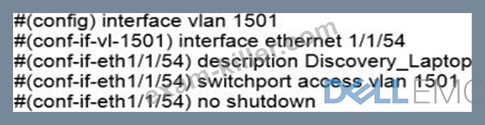
A Network administrator is failing to discover a PowerStore T system using the PowerStore Discovery Utility.
What might be the issue?
- A. Port 54 has not been set to trunk mode
- B. Port 54 needs to be enabled
- C. Dedicated port needs to be used for discovery network
- D. Discovery network uses only native VLAN
Answer: D
NEW QUESTION # 94
What does setting the alert threshold to 0 (zero) do when configuring replication rules?
- A. Generates an alert if the synchronization time exceeds the RPO.
- B. Generates an alert if the data saved during the RPO cycle exceeds 20% of the storage object capacity
- C. Enables alerts if the RPO cycle was missed for three consecutive cycles.
- D. Disables all alerts for any missed RPO cycles.
Answer: A
Explanation:
Here's a breakdown of how the alert threshold works in PowerStore replication:
RPO (Recovery Point Objective): The RPO defines the maximum acceptable amount of data loss in case of a disaster. It essentially determines how often data is replicated. For example, an RPO of 1 hour means you're willing to lose up to 1 hour's worth of data.
Alert Threshold: This setting allows you to control when PowerStore generates an alert if replication isn't meeting the defined RPO. It's the amount of time the system waits before raising an alert when a replication session fails to meet the RPO.
Threshold 0: When you set the alert threshold to 0, it means that PowerStore will immediately generate an alert if the synchronization time for a replication session takes longer than the RPO. This provides immediate notification of potential issues with replication performance or network connectivity.
Why other options are incorrect:
A . Disables all alerts for any missed RPO cycles: This is incorrect. Setting the threshold to 0 actually makes the system more sensitive to missed RPOs.
B . Generates an alert if the data saved during the RPO cycle exceeds 20% of the storage object capacity: This is not related to the alert threshold setting.
C . Enables alerts if the RPO cycle was missed for three consecutive cycles: The alert threshold doesn't have a built-in mechanism for consecutive missed cycles. It triggers an alert based on the synchronization time exceeding the RPO.
By setting the alert threshold to 0, you ensure that you're immediately notified of any replication delays, allowing you to take corrective action to prevent potential data loss.
NEW QUESTION # 95
What does a Storage Administrator need to consider about Resource Balance when assigning volumes?
- A. Whether the Cluster is offline
Node failure status
I/O utilization - B. Whether the Node is offline
Appliance failure status
Node utilization - C. Whether the appliance is offline
Appliance failure status
Capacity utilization - D. Whether the appliance is online
Appliance failure status
Cluster utilization
Answer: C
NEW QUESTION # 96
Refer to the exhibit.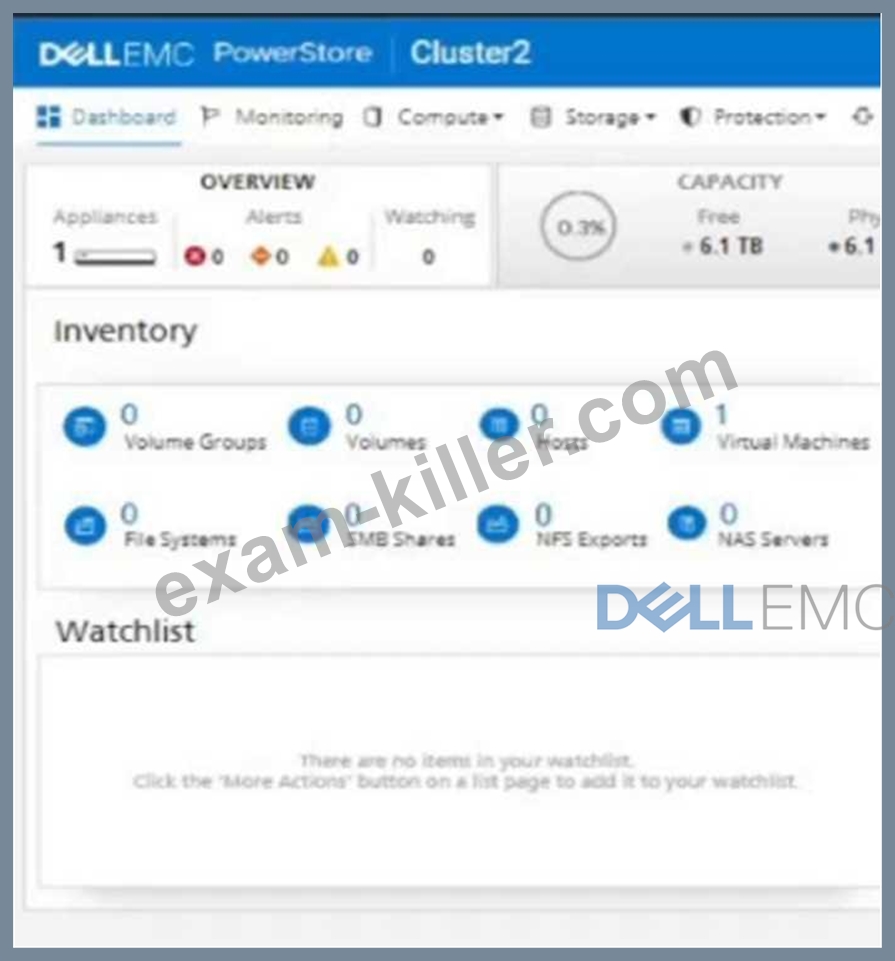
An administrator is setting up a new ESXi cluster using NVMe over TCP. The administrator is given the following parameters:
Volume Details
Name: nvme-ds-01
Category: Virtualization
Application: Containers/Kubernetes
Volume Performance Policy: High
Size: 2 TB
Host Details
Name: ESXi-01
Initiator Type: NVMe Host Mappings: NVMe
Use the simulator to add the host and the volume and give the host access to the volume using the above parameters.
When you have finished, continue to the next question.
Answer:
Explanation:
See the steps in Explanation.
1. On the simulator, click on theStoragetab on the left sidebar. Then click on theVolumessubtab. You will see a list of existing volumes on the cluster.
2. To create a new volume, click on theCreatebutton on the top right corner. A dialog box will appear where you can enter the volume details.
3. Enter the name of the volume asnvme-ds-01. Select the category asVirtualizationand the application asContainers/Kubernetes. These are optional fields that help you organize and identify your volumes.
4. Select the volume performance policy asHigh. This will optimize the volume for high performance and low latency. You can also customize the policy by clicking on theAdvancedbutton and adjusting the settings.
5. Enter the size of the volume as2 TB. You can also enable thin provisioning, compression, and deduplication if you want to save space and improve efficiency. Click on theCreatebutton to create the volume.
6. You will see a confirmation message that the volume has been created successfully. Click on theClosebutton to exit the dialog box. You will see the new volume in the list of volumes.
7. To add a new host, click on theHostssubtab on the left sidebar. You will see a list of existing hosts on the cluster.
8. To create a new host, click on theCreatebutton on the top right corner. A dialog box will appear where you can enter the host details.
9. Enter the name of the host asESXi-01. Select the initiator type asNVMe. This will enable the host to use the NVMe over TCP protocol to access the volumes.
10. To add the host mappings, click on theAdd Mappingbutton. A dialog box will appear where you can select the volume and the access type.
11. Select the volumenvme-ds-01from the drop-down menu. Select the access type asNVMe. This will map the volume to the host using the NVMe over TCP protocol. Click on theAddbutton to add the mapping.
12. You will see the mapping in the list of host mappings. You can add more mappings if you want to map more volumes to the host. Click on theCreatebutton to create the host.
13. You will see a confirmation message that the host has been created successfully. Click on theClosebutton to exit the dialog box. You will see the new host in the list of hosts.
14. You have completed the task of adding the host and the volume and giving the host access to the volume using the NVMe over TCP protocol. You can verify the configuration by clicking on the host or the volume and checking the details.
NEW QUESTION # 97
Which two migration tasks are configured during a non-disruptive import in PowerStore? (Choose two.)
- A. Refresh Volumes
- B. Start Copy
- C. Refresh Hosts
- D. Host Cleanup
Answer: A,B
NEW QUESTION # 98
An administrator is attempting to remove a remote replication session for a test volume. The administrator selects the test volume from the Storage tab. From the More Actions dropdown list the Unassign Protection Policy is selected.
In the Unassign Protection Policy confirmation window the administrator clicks the Unassign button and receives a Modify Volume error.
What is the cause of the error?
- A. Operation was performed from the replication destination
- B. Replication rule was not deleted from the protection policy
- C. Protection policy replication rule RPO value was not set to zero
- D. Replication session was not paused before the protection policy was unassigned
Answer: A
NEW QUESTION # 99
Which IP addresses are required when adding an appliance to the cluster?
- A. Management and Storage
- B. DNS and NTP
- C. Storage and NTP
- D. Management and DNS
Answer: A
NEW QUESTION # 100
A PowerStore administrator is creating a host group.
Which two protocol types can be selected for a new host group? (Choose two.)
- A. FC
- B. InfiniBand
- C. NVMe/TCP
- D. iSCSI
Answer: A,D
Explanation:
Host Groups and Supported Protocols in PowerStore
Host Groups: Host groups in PowerStore allow you to group multiple hosts together for easier management and access control. When you create a host group, you specify the protocol that the hosts in that group will use to connect to the PowerStore appliance.
Supported Protocols: PowerStore supports several protocols for host connectivity, but when creating a host group, you can choose from these two:
iSCSI: A widely used IP-based storage networking protocol.
FC (Fibre Channel): A high-speed network technology primarily used for storage networking.
Why other options are incorrect:
A . InfiniBand: While PowerStore supports InfiniBand for NVMe over Fabrics (NVMe-oF), it's not a selectable option when creating a host group.
C . NVMe/TCP: Similar to InfiniBand, NVMe/TCP is supported for NVMe-oF, but it's not a protocol choice during host group creation.
Key Considerations for Host Groups
Single Protocol per Host Group: A host group can only use one protocol. All hosts within the group must use the same protocol (either iSCSI or FC) to connect to PowerStore.
Host Mapping: After creating a host group, you can map volumes to the group, granting access to all hosts within that group.
Dell PowerStore Reference
PowerStore: Hosts and Host Groups: This section in the PowerStore documentation provides detailed information about creating and managing host groups, including the supported protocols.
NEW QUESTION # 101
At what point in the configuration of a non-disruptive Import session is the storage resource provisioned on the PowerStore system?
- A. At the Begin Import step of the Import Storage wizard.
- B. When the ImportKit is installed on the host.
- C. Before the remote system is added to PowerStore.
- D. As part of the verify iSCSI availability process.
Answer: A
NEW QUESTION # 102
......
EMC D-PST-DY-23 (Dell PowerStore Deploy 2023) Certification Exam is designed to test the knowledge and skills of individuals regarding the deployment of Dell PowerStore 2023 solutions. D-PST-DY-23 exam is intended for professionals who have experience in planning, deploying, managing, and supporting Dell PowerStore solutions. Dell PowerStore Deploy 2023 Exam certification exam covers various topics such as Dell PowerStore architecture, networking, storage provisioning, data protection, and system administration. Passing the EMC D-PST-DY-23 certification exam validates that an individual has the necessary skills and knowledge to deploy Dell PowerStore 2023 solutions in a production environment.
The D-PST-DY-23 exam is intended for professionals who have experience working with Dell PowerStore storage solutions. This includes storage administrators, system administrators, and IT professionals who are responsible for deploying, configuring, and managing storage solutions. D-PST-DY-23 exam covers a wide range of topics, including Dell PowerStore architecture, deployment planning, storage provisioning, and data protection. It also covers advanced topics such as multi-cloud integration, automation, and analytics.
New D-PST-DY-23 exam dumps Use Updated EMC Exam: https://pass4sure.exam-killer.com/D-PST-DY-23-valid-questions.html
