
Instantly download CKAD updated real questions

Pass your actual test at first attempt with Linux Foundation CKAD training material
Updated: Nov 17, 2026
No. of Questions: 239 Questions & Answers with Testing Engine
Download Limit: Unlimited
Get valid CKAD real exam questions for easy pass!
Exam-Killer CKAD updated and latest training material covers the main exam objectives of the actual test, which can ensure you pass easily. Free update for one year of CKAD training material is available after purchase. Besides, our CKAD test engine can simulate the actual test environment for better preparation.
100% Money Back Guarantee
Exam-Killer has an unprecedented 99.6% first time pass rate among our customers.  We're so confident of our products that we provide no hassle product exchange.
- Best exam practice material
- Three formats are optional
- 10 years of excellence
- 365 Days Free Updates
- Learn anywhere, anytime
- 100% Safe shopping experience
- Instant Download: Our system will send you the products you purchase in mailbox in a minute after payment. (If not received within 12 hours, please contact us. Note: don't forget to check your spam.)
CKAD Online Engine

- Online Tool, Convenient, easy to study.
- Instant Online Access
- Supports All Web Browsers
- Practice Online Anytime
- Test History and Performance Review
- Supports Windows / Mac / Android / iOS, etc.
- Try Online Engine Demo
CKAD Self Test Engine

- Installable Software Application
- Simulates Real Exam Environment
- Builds CKAD Exam Confidence
- Supports MS Operating System
- Two Modes For Practice
- Practice Offline Anytime
- Software Screenshots
CKAD Practice Q&A's

- Printable CKAD PDF Format
- Prepared by CKAD Experts
- Instant Access to Download
- Study Anywhere, Anytime
- 365 Days Free Updates
- Free CKAD PDF Demo Available
- Download Q&A's Demo
Linux Foundation CKAD Exam Overview:
| Certification Vendor: | Linux Foundation |
|---|---|
| Exam Name: | Certified Kubernetes Application Developer (CKAD) Exam |
| Exam Number: | CKAD |
| Exam Price: | $445 USD |
| Related Certifications: | Certified Kubernetes Security Specialist (CKS) Certified Kubernetes Administrator (CKA) |
| Exam Duration: | 120 minutes |
| Certificate Validity Period: | 2 years |
| Available Languages: | Simplified Chinese, English, Japanese |
| Exam Format: | Performance-based, Hands-on tasks, Command-line based |
| Passing Score: | 66% |
| Real Exam Qty: | 15-20 |
| Recommended Training: | Introduction to Kubernetes Kubernetes for Developers (LFD259) |
| Exam Registration: | Official Registration |
| Sample Questions: | Linux Foundation CKAD Sample Questions |
| Exam Way: | Online, remotely proctored |
| Pre Condition: | No formal prerequisites |
| Official Syllabus URL: | https://training.linuxfoundation.org/certification/certified-kubernetes-application-developer-ckad/ |
What do I need to know to use it?
You should understand the following key concepts to use Kubernetes correctly. Exponentially growing technology. Bookmarks are easy to manage. Bookmarks are used to keep track of the apps you have on your computer. It's used to define data volumes that are shared between various machines. The best practices will be provided on the matter. It's complex because it is based on a microservices architecture. Rocketman Technologies is a software development company that provides leading edge and innovative solutions to take your business to the next level. Separate a service from a specific deployment. It also integrates with various platforms. C is the de facto programming language for Linux systems. Objectives are achieved in a way that suits usage scenarios best. Download a free trial of Kubernetes today. It is based on four major objectives. The following things can be automated with Kubernetes. Cisco is the global leader in IT and communications technology.
Reference: https://training.linuxfoundation.org/certification/certified-kubernetes-application-developer-ckad/
Exam Topics for CNCF Certified Kubernetes Application Developer
Our CNCF CKAD Dumps covers the following objectives of the CNCF Certified Kubernetes Application Developer Exam.
- Multi-Container Pods 10%
- Services & Networking 13%
- Pod Design 20%
- Core Concepts 13%
- Observability 18%
- Configuration 18%
- State Persistence 8%
Linux Foundation CKAD Exam Syllabus Topics:
| Section | Weight | Objectives |
|---|---|---|
| Topic 1: Services and Networking | 20% | - Understand and apply NetworkPolicies - Troubleshoot network access - Use Ingress rules - Expose applications via Services |
| Topic 2: Application Deployment | 20% | - Use Helm package manager - Implement deployment strategies - Manage Deployments, rolling updates and rollbacks - Work with Kustomize |
| Topic 3: Application Observability and Maintenance | 15% | - Work with container logs - Monitor applications using CLI tools - Debug applications in Kubernetes - Implement probes and health checks - Understand API deprecations |
| Topic 4: Application Environment, Configuration and Security | 25% | - Create and consume Secrets - Apply application security settings - Use custom resources and extensions - Understand authentication, authorization and admission control - Configure resource requirements, limits and quotas - Use ServiceAccounts - Work with ConfigMaps |
| Topic 5: Application Design and Build | 20% | - Choose and use appropriate workload resources - Define, build and modify container images - Understand multi-container Pod design patterns - Utilize persistent and ephemeral volumes |
Linux Foundation Certified Kubernetes Application Developer Sample Questions:
You have a Deployment named 'my-app-deployment' running a Flask application. You need to configure a rolling update strategy with a maximum of one pod unavailable at any time. You also want to trigger an automatic update whenever a new image is pushed to the Docker Hub repository. Additionally, you want to analyze the application logs during the update process to ensure everything is working smoothly. How would you achieve this?
Reveal Solution Discussion 0Correct Answer:
See the solution below with Step by Step Explanation.
Explanation:
Solution (Step by Step) :
1. Configure Deployment with Rolling Update:
- Update the 'my-app-deployment' Deployment configuration to include the following:
- 'replicas': Set to 2 to ensure a rolling update with a maximum of one unavailable pod.
- 'maxUnavailable: 1': This specifies that a maximum of one pod can be unavailable during the update.
- 'maxSurge: 0': This ensures no new pods are created beyond the desired replicas.
- 'imagePullPolicy: Always': This forces the pods to pull the latest image from the repository.
- 'strategy.type: RollingUpdate': Specifies the rolling update strategy.
2. Apply Deployment Configuration: - Apply the updated YAML file to your cluster: 'kubectl apply -f my-app-deployment.yamr 3. Analyze Application Logs: - To monitor the logs of your Flask application, utilize a tool like 'kubectl logs' or a dedicated logging service like Fluentd or ElasticSearch. - Example using 'kubectl logs' bash kubectl logs -f my-app-deployment-pod-name - During the rolling update, closely watch the logs for errors or warnings to ensure smooth transitions. 4. Trigger an Automatic Update: - Push a new image with updates to the 'my-app-image:latest' Docker Hub repository. 5. Monitor the Deployment: - Use 'kubectl get pods -l app=my-app' to monitor the pods during the rolling update. 6. Verify Deployment Status: - Check the status of the Deployment using 'kubectl describe deployment my-app-deployment' . The 'updatedReplicas' field should match the 'replicas' field, indicating a successful update.
You are running a web application within a Kubernetes cluster. The application consists of two pods, each with a resource request of 1CPU core and I GiB of memory. However, you've noticed that the application experiences performance issues during peak traffic hours. To mitigate these issues, you decide to implement resource quotas tor the namespace where the application runs. You want to ensure that the application pods receive adequate resources while preventing other applications from consuming excessive resources. Design and implement a resource quota for the namespace that sets limits for CPU and memory resources.
Reveal Solution Discussion 0Correct Answer:
See the solution below with Step by Step Explanation.
Explanation:
Solution (Step by Step) :
1. Define the Resource Quota:
- Create a YAML file (e.g., resource-quota.yaml') containing the following resource quota configuration:
2. Apply the Resource Quota: - Apply the resource quota to the 'web-app' namespace using the following command: bash kubectl apply -f resource-quota-yaml 3. Verify the Resource Quota: - Check the status of the resource quota using the following command: bash kubectl get resourcequotas -n web-app You should see the 'web-app-quota' listed with its defined limits and requests. 4. Monitor Resource Usage: - Use the 'kubectl describe resourcequota web-app-quota -n web-apps command to monitor the current resource usage within the 'web-apps namespace- This will show you the consumed resources against the defined limits. 5. Adjust the Resource Quota: - If the resource quota is too restrictive or not restrictive enough, you can adjust the values in the 'requests' and 'limits' fields in the 'resource. quota.yaml file and reapply the resource quota using 'kubectl apply'. - The resource quota limits the total amount of resources (CPU and memory) that can be consumed by all pods in the 'web-app' namespace. - The requests' field specifies the total amount of resources that pods in the namespace can request. - The 'limits' field sets a hard limit on the total amount of resources that pods can use, preventing them from exceeding these limits. - This ensures that the web application has access to the required resources while preventing other applications in the namespace from consuming all available resources. ,
You are building a microservices architecture for a web application. One of your services handles user authentication. To ensure the service remains available even if one of the pods fails, you need to implement a high-availability solution. Design a deployment strategy for the authentication service that utilizes Kubernetes features to achieve high availability and fault tolerance.
Reveal Solution Discussion 0Correct Answer:
See the solution below with Step by Step Explanation.
Explanation:
Solution (Step by Step) :
1. Deploy as a StatefuISet:
- Use a StatefuISet to deploy your authentication service. StatefuISets maintain persistent storage and unique identities for each pod, ensuring that data is preserved and the service can recover from failures without losing state.
2. I-Ise Persistent Volumes: - Provision persistent volumes for each pod in the StatefulSet to store sensitive data like user credentials or session information. This ensures that the data persists even if a pod iS restarted or replaced. 3. Configure a Service with Load Balancing: - Create a Service that uses a load balancer (like a Kubernetes Ingress or external load balancer) to distribute traffic across the replicas of your authentication service. This ensures that requests are evenly distributed, even if some pods are down.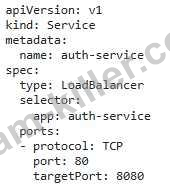
4. Implement Health Checks: - Set up liveness and readiness probes for the authentication service. Liveness probes ensure that unhealthy pods are restarted, while readiness probes ensure that only nealtny pods receive traffic. 5. Enable TLS/SSL: - Secure your authentication service with TLS/SSL to protect sensitive user data during communication. You can use certificates issued by a certificate authority (CA) or self-signed certificates for development environments. 6. Consider a Distributed Cache: - For improved performance and scalability, consider using a distributed cache like Redis or Memcached to store frequently accessed data, such as user authentication tokens. This can reduce the load on the authentication service and improve user response times.
You are tasked witn building a container image for a Node.js application that needs to interact with a MongoDB database. Describe now you would configure your Dockerfile to include MongoDB and how you would set up your Node.js application to connect to the database within the container.
Reveal Solution Discussion 0Correct Answer:
See the solution below with Step by Step Explanation.
Explanation:
Solution (Step by Step) :
1. Utilize a Multi-Stage Dockerfile: Employ a multi-stage Dockerfile to separate the build and runtime environments, optimizing the final image size.
2. Install MongoDB in the Base Image: - Use a suitable MongoDB base image, such as 'mongo:latest', in the runtime stage. 3. Install Node.js Dependencies: - IJse a Nodejs base image, such as 'node:16-alpine', in the build stage. - Install Node.js dependencies using 'yarn install'. 4. Connect to MongoDB from the Node.js Application: - In your Node.js application, use a MongoDB driver (e.g., 'mongodb') to establish a connection to the MongoDB instance.
5. Build and Run the Container: - Build the image using 'docker build . -t my-node-mongo-apps - Run the container using 'docker run -it -p 2701727017 my-node-mongo-app' - The '-p 27017:27017' mapping exposes the MongoDB port to your host machine, allowing you to connect to the database from your local machine. 6. Access MongoDB. - You can use a MongoDB client tool (e.g., Mongo Shell, Robo 3T) or other applications to connect to the MongoDB instance running inside the container.,
You have a Node.js application that runs in a Kubernetes cluster. The application requires access to a MySQL database hosted externally on a different server. Due to security concerns, you cannot directly expose the database to the application pod. Describe how you can implement a network policy to enable secure communication between the application pod and the MySQL database.
Reveal Solution Discussion 0Correct Answer:
See the solution below with Step by Step Explanation.
Explanation:
Solution (Step by Step) :
1. Create a Network Policy:
- Create a Network Policy that allows traffic only from the application pods to the MySQL database server-
- Define the podSelector' to specify the application pods that should be allowed to connect to the database.
- Use 'ingress' rules to define the allowed incoming traffic from the application pods.
- Specify the 'from' field to identify the source pods using labels or namespaces-
- Set the 'to' field to specify the target IP address or range of the MySQL database server
2. Deploy the Network Policy: - Apply the Network Policy to your Kubernetes cluster using 'kubectl apply -f mysql-access.yamr 3. Configure the Application: - Configure your Node.js application to connect to the MySQL database using the IP address or hostname of the database server. - Ensure that the Node.js application has appropriate security credentials to access the database. 4. Test the Application: - Run your application and verify that it can connect to the MySQL database successfully. Note: This example provides a basic implementation. You might need to adjust the configuration based on your specific security requirements and network setup. You can further enhance the network policy by using specific ports, protocols, and other security measures as needed.,
Viewing page 1 out of 48 pages.
Viewing questions 1-5 out of 239 questions.
CKAD exam braimdump is a must have for practicing real Q&A. Thanks! I wrote my exam yeasterday and passed it successfully.
 By Frank
Thank you for the CKAD exam dumps. By using them to revise for my test was the best thing. I did so well in my CKAD exam.
By Hyman
I just took my CKAD exam and passed in United States.
By Lennon
These CKAD exam braindumps gave me topical material. That's how i saved my time and passed the exam.
By Murray
The CKAD exam questions are so efficient that no other guide provides such accuracy. I passed with 99% scores. Great!
By Jack
I’m glad for someone recommended me the right CKAD exam dump. I passed the CKAD exam only with it. I can’t stop feeling thankful.
By Lou
Disclaimer Policy: The site does not guarantee the content of the comments. Because of the different time and the changes in the scope of the exam, it can produce different effect. Before you purchase the dump, please carefully read the product introduction from the page. In addition, please be advised the site will not be responsible for the content of the comments and contradictions between users.

Exam-Killer CKAD latest torrent pdf is a great help in preparing for your actual exam that covers the latest exam objectives. All the contents of CKAD study material are written and compiled by professional experts with the high quality and high pass rate, which can ensure you 100% pass.
Besides, we have the money back guarantee on the condition of failure. You just need to show us the failure score report and we will refund you after confirming.
Frequently Asked Questions
What products does Exam-Killer offer?
Test Engine: CKAD study test engine can be downloaded and run on your own devices. Practice the test on the interactive & simulated environment.
PDF (duplicate of the test engine): the contents are the same as the test engine, support printing.
How long can I get the CKAD products after purchase?
You will receive an email attached with the CKAD study material within 5-10 minutes, and then you can instantly download it for study. If you do not get the study material after purchase, please contact us with email immediately.
How often do you release your CKAD products updates?
All the products are updated frequently but not on a fixed date. Our professional team pays a great attention to the exam updates and they always upgrade the content accordingly.
Are your study material updated free? How to get?
Yes, you will enjoy one year free update after purchase. If there is any update, our system will automatically send the updated study material to your payment email.
How does your Testing Engine works?
Once download and installed on your PC, you can practice CKAD test questions, review your questions & answers using two different options 'practice exam' and 'virtual exam'.
Virtual Exam - test yourself with exam questions with a time limit.
Practice Exam - review exam questions one by one, see correct answers.
What's the applicable operating system of the CKAD test engine?
Online Test Engine can supports Windows / Mac / Android / iOS, etc., because it is the software based on WEB browser. You can use it on any electronic device and practice with self-paced.
Online Test Engine supports offline practice, while the precondition is that you should run it with the internet at the first time.
Self Test Engine is suitable for windows operating system, running on the Java environment, and can install on multiple computers.
PDF Version: can be read under the Adobe reader, or many other free readers, including OpenOffice, Foxit Reader and Google Docs.
Do you have any discounts?
We offer some discounts to our customers. There is no limit to some special discount. You can check regularly of our site to get the coupons.
Do you have money back policy? How can I get refund if fail?
Yes. We have the money back guarantee in case of failure by our products. The process of money back is very simple: you just need to show us your failure score report within 60 days from the date of purchase of the exam. We will then verify the authenticity of documents submitted and arrange the refund after receiving the email and confirmation process. The money will be back to your payment account within 7 days.
Over 67295+ Satisfied Customers

Our Clients


Our latest test questions will provide the best valid and accurate knowledge for you and give you right reference. You will successfully pass your actual test with the help of our high quality and high hit-rate pass4sure study torrent.
Contact Us
From Monday to Saturday
Support: Contact now
If you have any question please leave me your email address, we will reply and send email to you in 12 hours.
Copyright © 2026 EXAM-KILLER.COM. All rights reserved. All trademarks are the property of their respective owners and we don't provide actual questions from any vendor. Privacy Policy